
Dancing Galaxies: How Cosmic Collisions Fuel Supermassive Black Holes
Cosmic research reveals galaxy mergers fuel supermassive black holes, sparking titanic eruptions, with new AI insights. What mysteries lie within these cosmic dances?

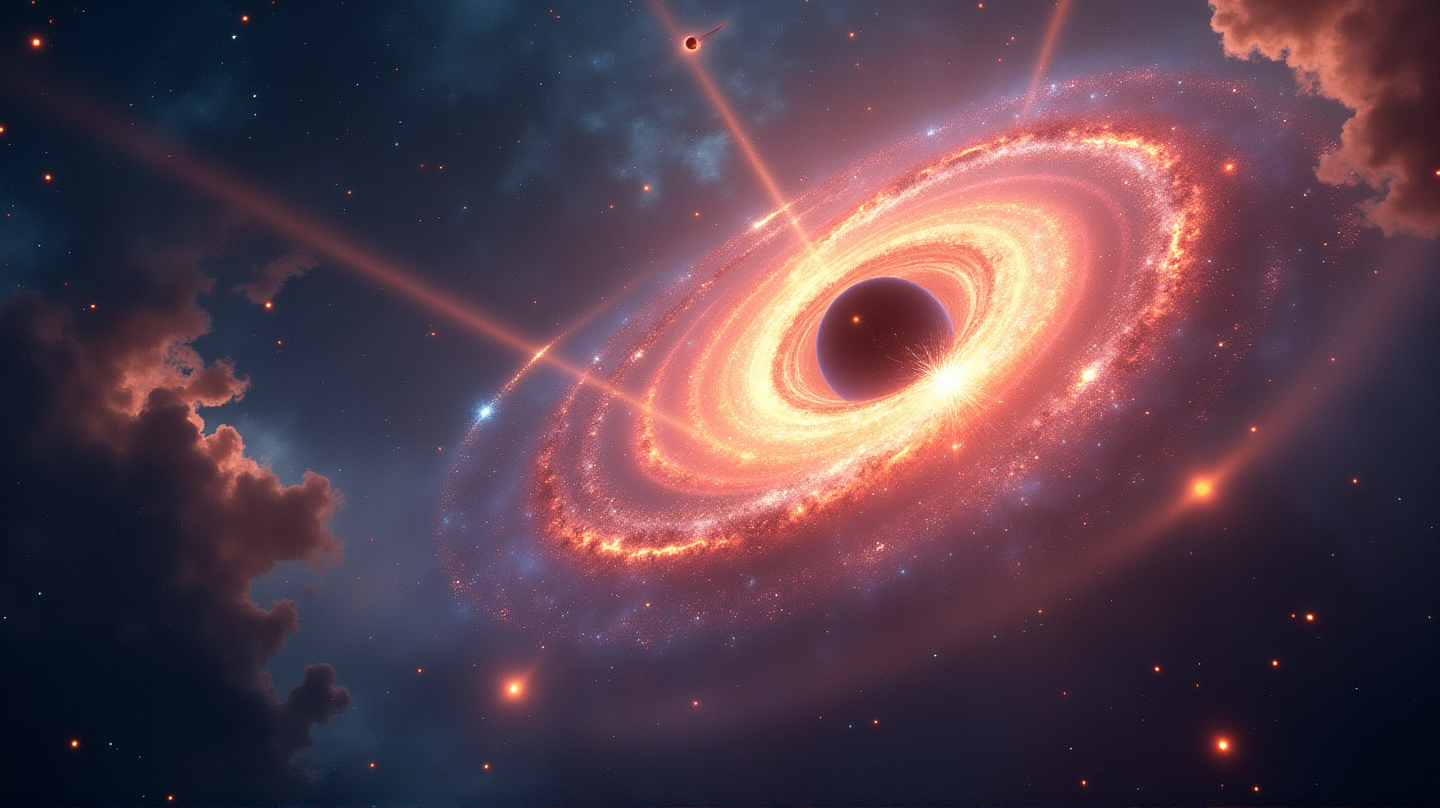
In the vast theater of the cosmos, where light-years span like dreamt horizons and time itself seems to languish, a wondrous play unfolds: the dance of galaxies. These colossal structures of stars and dust whirl and merge, engaging in celestial choreographies that may unlock the deepest mysteries of the universe. But what happens when two galaxies collide? According to new research, such cosmic mergers may indeed activate supermassive black holes, igniting spectacular eruptions at the heart of these galactic colossi.
The Euclid Revelation
How do we witness this astral ballet? Enter the Euclid space telescope, a marvel of modern technology launched by the European Space Agency in 2023. With its 1.2-meter mirror and 600-megapixel camera, Euclid charts an awe-inspiring million galaxies, chronicling the hidden tales that unfold within them. As stated in Space, this telescope not only studies dark matter but reveals the deep symphonic nature of galaxies’ interstellar interactions.
Unveiling Active Galactic Nuclei
At the heart of each galaxy lies the mighty protagonist—a supermassive black hole. Yet, it is during these cataclysmic encounters that the dynamics truly shift, awakening the central giant into an active galactic nucleus (AGN). Encircling it is an accretion disk, a glowing whirlpool where gas and particles bide their time before plunging into the abyss. Imagine beams of charged particles whirling forth, illuminating the cosmic web and forming quasars and blazars that defy our imaginations.
The Role of AI in Galaxy Discovery
Thanks to breakthroughs in artificial intelligence, researchers have honed the ability to discern AGNs amidst the choreography of galaxies. Berta Margalef-Bentabol and Lingyu Wang from SRON developed an AI tool capable of identifying these celestial phenomena, offering, as Juan Antonio la Marca of the University of Groningen attests, the potential to gauge their luminosity. This new method uncovers even the faintest AGNs that standard approaches might overlook, deepening our understanding of galaxy evolution.
Mergers As Catalysts for AGN Activity
Researchers observed a stark difference in AGN frequencies between merging and non-merging galaxies. Those caught in the cosmic embrace are six times more likely to harbor active black holes, particularly in dusty, burgeoning encounters. As mergers grow older and the cosmic dust settles, the effects are still twice as pronounced compared to galaxies that journey alone. This insight underscores the profound influence that these dances have on the activation of supermassive black holes.
Implications for Cosmic Evolution
The significance of these findings resonates far beyond the realm of pure astronomy. The AGN’s outpouring of energy reshapes its host galaxy, heating molecular gas and stalling star formation—a cosmic domino effect that bears greatly on the galaxy’s evolutionary trajectory. Understanding the catalysts of these phenomena is crucial for modeling cosmic evolution and provides profound insights into our universe’s intricate tapestry.
As research continues and the dance of galaxies unfurls, humanity peers ever deeper into the cosmos, ready to embrace the eternal mysteries that weave the fabric of our universe.